
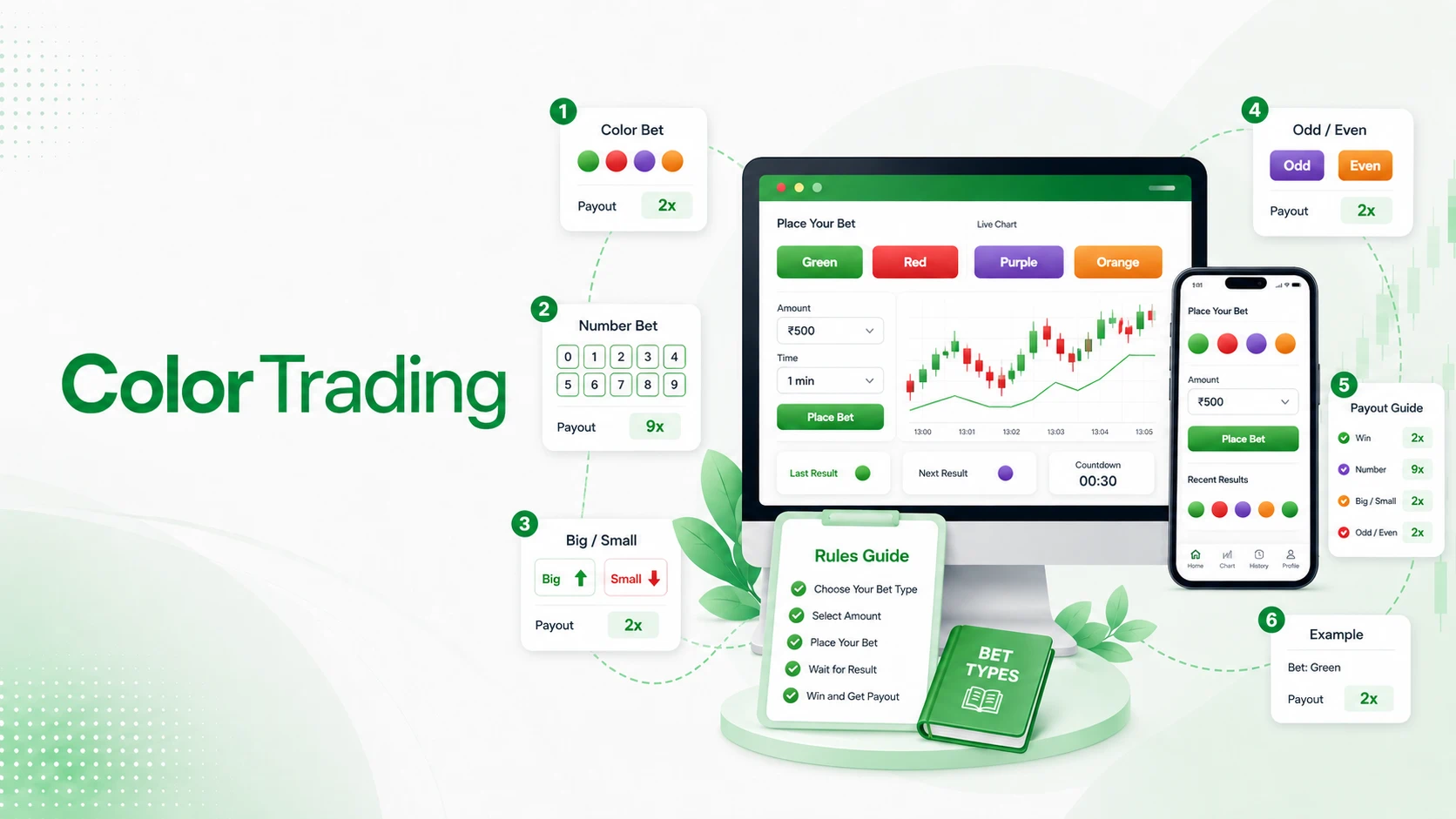
Colour Trading Rules Explained: Every Bet Type and What It Pays
In Colour Trading, players bet on the outcome of a round timer — choosing from colour bets (Red, Green, Violet), number bets (0–9), or Big/Small bets before the window locks. Each number from 0 to 9 is assigned a colour, and payouts range from 2x for colour and Big/Small bets up to 9x for exact number bets. Every round is independent.
Why the Rules Matter More Than the Strategy
Most players jump straight to looking for patterns. The results history, streaks, “hot” colours — all of it feels meaningful when you’re in the middle of a session.
None of it is. Every round is generated independently. There are no patterns to exploit.
What does matter is understanding exactly what you’re betting on. A lot of money is lost by players who don’t fully grasp the colour-number relationship, or who misread how Violet payouts work, or who don’t realise that 0 and 5 are split-colour numbers. These aren’t complex rules — but they’re the rules where confusion costs real money.
If you want to start from the very beginning, what is colour trading explains the full game concept before you reach the betting rules. This article goes deeper into the mechanics.
The Core Rule: One Number, Multiple Betting Angles
Every round in Colour Trading produces a single result: a number from 0 to 9. That number simultaneously determines:
- The colour (Red, Green, or Violet)
- The size (Big = 5–9, Small = 0–4)
- The exact number (relevant if you placed a number bet)
Your bet is resolved against whichever of these you selected. You can place multiple bets on the same round — for example, a colour bet and a number bet simultaneously — and each resolves independently.
Colour Bets: Red, Green, and Violet
This is where most players start. You pick a colour and wait to see if the round result falls under it.
| Colour | Covers These Numbers | Payout |
|---|---|---|
| Red | 2, 4, 6, 8 (full) + 0 (partial) | 2x (full), reduced on 0 |
| Green | 1, 3, 7, 9 (full) + 5 (partial) | 2x (full), reduced on 5 |
| Violet | 0 and 5 only | 4.5x |
Red and Green each cleanly cover four numbers. The partial overlap on 0 and 5 is worth understanding in detail.
Violet only wins when the result is 0 or 5 — two specific numbers out of ten. Because it covers fewer outcomes, the payout is 4.5x rather than 2x. The higher reward reflects the lower probability.
The 0 and 5 Edge Case
Numbers 0 and 5 carry two colours: 0 is Red + Violet, and 5 is Green + Violet.
If you bet Red and the result is 0:
– You receive a partial payout (not the full 2x), because 0 is also a Violet number
– The platform’s exact partial return varies — check before betting on these edge numbers
If you bet Violet and the result is 0 or 5:
– You receive the full 4.5x payout
This is one of the most commonly misunderstood rules for new players. Many players expect a full Red win when 0 appears after betting Red — they don’t get it, and they assume something is wrong. It’s not wrong; it’s the split-colour rule.
Number Bets: 0 to 9
You predict the exact number that will appear. If correct, you win 9x your bet.
| Bet | Condition | Payout |
|---|---|---|
| Any single number (0–9) | Exact match | 9x |
This is the highest-payout bet type in the game. It’s also the highest-risk: you’re predicting 1 specific outcome out of 10 possible results.
Most experienced players use number bets for smaller side amounts — a smaller stake riding on a higher multiplier — rather than as their primary bet. As a beginner, understand they exist, but don’t build your session around them until you’re comfortable with the game’s rhythm.
Big / Small Bets
| Bet | Covers | Payout |
|---|---|---|
| Big | 5, 6, 7, 8, 9 | 2x |
| Small | 0, 1, 2, 3, 4 | 2x |
Big/Small is the simplest bet in the game. Each covers exactly five numbers, the payout is 2x, and there’s no colour-number mapping to consider.
For pure beginners, this is the most transparent starting point. You’re essentially splitting the 10 numbers in half and choosing a side. The odds are close to 50/50 (accounting for house edge), and the payout structure is straightforward.
The limitation: Big/Small tells you very little about the game’s full structure. Once you understand colour and number bets, Big/Small becomes one tool among several rather than the whole game.
The Colour-Number Map
Every number has an assigned colour. Memorising this is worth doing early — it removes confusion when results appear and you’re trying to understand whether your colour bet won.
| Number | Primary Colour | Secondary |
|---|---|---|
| 0 | Red | Violet |
| 1 | Green | — |
| 2 | Red | — |
| 3 | Green | — |
| 4 | Red | — |
| 5 | Green | Violet |
| 6 | Red | — |
| 7 | Green | — |
| 8 | Red | — |
| 9 | Green | — |
Even numbers (except 0): Red. Odd numbers (except 5): Green. Numbers 0 and 5: split with Violet.
House Edge: What the Rules Don’t Say Out Loud
The payout structure is designed so that the platform retains a small percentage of total bets over time. This is the house edge — it exists in every Colour Trading game, just as it does in all similar games.
It doesn’t mean you can’t win in the short term. It means the game isn’t designed to be consistently profitable over a large number of rounds. Understanding this changes how you should think about session limits.
A short, controlled session with a predefined stop point is a fundamentally different risk profile than an open-ended session where you keep playing until you’re down. The rules don’t stop you from playing indefinitely — your own limits do.
Three Rules That Catch Beginners Off Guard
1. The betting window locks before the timer hits zero.
Don’t wait until the last second to confirm your bet. There’s a brief lock period before the result appears — bets placed during this window don’t register.
2. Violet doesn’t mean “neither Red nor Green.”
Violet is specifically 0 and 5. If you’re expecting Violet to appear frequently just because a Red-Green streak has been running, that’s pattern-chasing, not rules-based reasoning.
3. Past results don’t affect future ones.
The result history panel shows what happened — it has no predictive value. Most colour trading players lose early not because they picked the wrong colours, but because they made increasingly large bets based on patterns that didn’t exist.
Before You Bet With Real Money
The rules are simple enough to learn in a few rounds. Applying them without the pressure of real money is easier.
Demo mode gives you the actual game — same timer, same bet types, same results — using virtual credits. Running through 10–20 rounds in demo teaches you the mechanics faster than reading about them. Once you understand how 0 and 5 behave, how the lock timing feels, and what different payouts look like in practice, your first real session starts from a position of knowledge rather than guesswork.
The rules are your edge. Know them before you use them.
Disclaimer: Colour Trading is a game of chance. The information in this article describes game mechanics only — it does not guarantee any outcome or return. Play responsibly and within your limits.
Frequently Asked Questions
What happens when the result is 0 in Colour Trading?
Number 0 is a split-colour number — it belongs to both Red and Violet. If you bet Red and the result is 0, you receive a partial payout (less than the standard 2x). If you bet Violet, you receive the full 4.5x payout. If you bet Small, you win 2x since 0 falls in the Small range (0–4).
Why does Violet pay 4.5x instead of 2x?
Violet only wins when the result is 0 or 5 — just two specific numbers out of ten possible outcomes. The higher payout compensates for the lower probability of winning. Red and Green each cover four numbers cleanly, which is why they pay the standard 2x.
Can I place multiple bets on the same round?
Yes. You can bet on a colour and a specific number simultaneously in the same round. Each bet is resolved independently based on the result. Placing multiple bets doesn’t increase or decrease the overall probability of any particular outcome.
Is there a strategy for winning at Colour Trading?
The game is based on random number generation — no strategy guarantees a positive outcome over time. What strategy can do is help you manage your session more effectively: controlling bet size, setting stop-loss limits, and avoiding common errors like chasing losses. For a practical breakdown of what actually helps, see how to play colour trading.